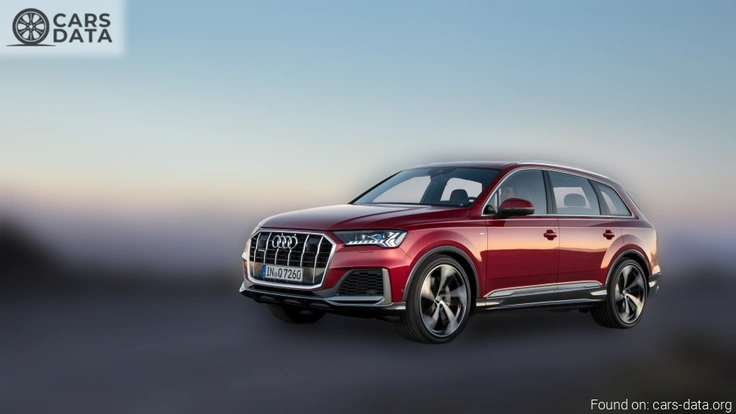
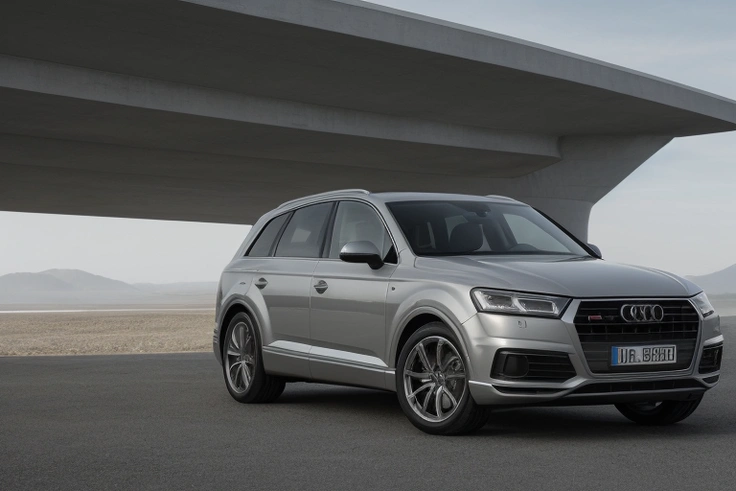
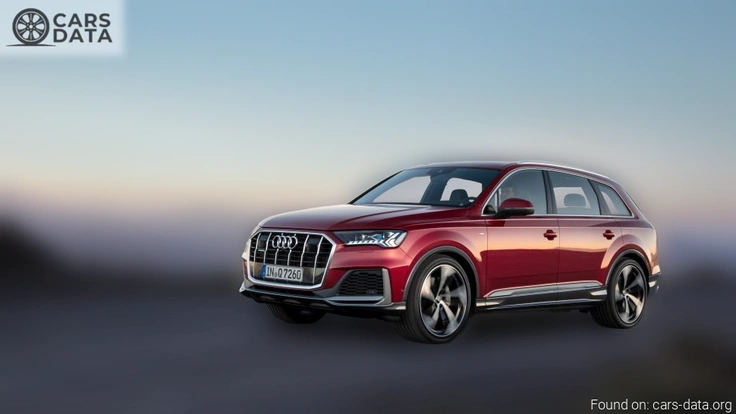
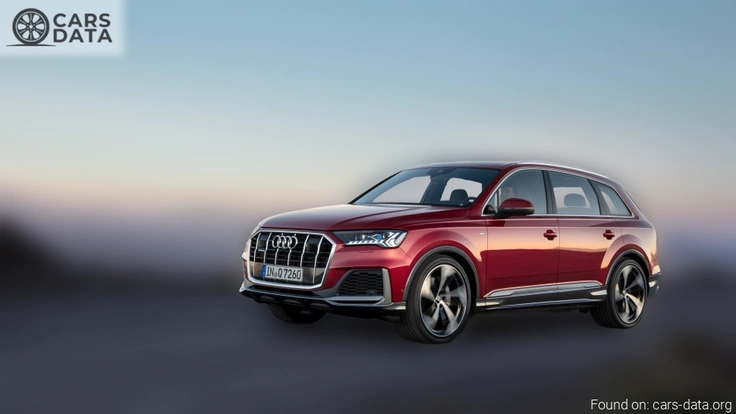
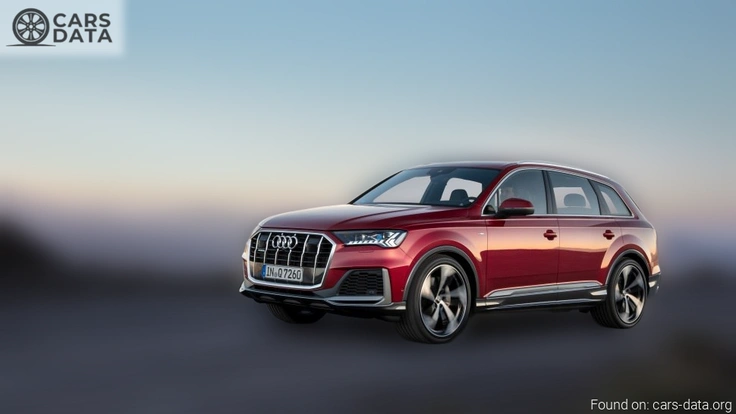
The Q7 model has an impressive acceleration, going from 0 to 100 km/h in 6.1 seconds, which is equivalent to 0-62 mph. It has a maximum speed of 241 km/h (149.75 mph) and a low drag coefficient of 0.32, indicating excellent aerodynamics.
Specs
-
Rating
Acceleration 0 100 Kmh
6.1 sec
Acceleration 0 62 Mph
6.1 sec
Max Speed
241 km/h 149.75 mph
Drag Coefficient Cd
0.32
Body & Dimensions
The Audi Q7 is a 7-seater SUV with a length of 5063 mm (199.33 in) and a width of 1970 mm (77.56 in). The height of the vehicle is 1740 mm (68.5 in) and the wheelbase is 2995 mm (117.91 in). The car has a minimum turning circle of 12.5 m (41.01 ft) and a front track of 1679 mm (66.1 in). The approach angle is 24.1° and the departure angle is 14.4°.
Specs
-
Rating
Body Type
SUV
Seats
7
Doors
5
Length
5063 mm 199.33 in.
Width
1970 mm 77.56 in.
Width Including Mirrors
2212 mm 87.09 in.
Height
1740 mm 68.5 in.
Wheelbase
2995 mm 117.91 in.
Front Track
1679 mm 66.1 in.
Rear Track
1690 mm 66.54 in.
Front Overhang
977 mm 38.46 in.
Rear Overhang
1092 mm 42.99 in.
Min Turning Circle
12.5 m 41.01 ft.
Approach Angle
24.1°
Departure Angle
14.4°
Fuel Consumption
The Audi Q7 boasts impressive fuel efficiency and environmental credentials, featuring a Euro 6d-ISC-FCM emission standard and a combined fuel consumption range of 7.8-8.5 l/100 km. Despite its size, the Q7 offers competitive fuel consumption figures and CO2 emissions.
Specs
-
Rating
Fuel Type
Diesel
Emission Standard
Euro 6d-ISC-FCM
Combined Fuel Consumption Wltp
7.8-8.5 l/100 km 30.16 - 27.67 US mpg 36.22 - 33.23 UK mpg 12.82 - 11.76 km/l
7.1-7.3 l/100 km 33.13 - 32.22 US mpg 39.79 - 38.7 UK mpg 14.08 - 13.7 km/l
Co2 Emissions Nedc Wltp Equivalent
186-192 g/km
Engine & Transmission
The car in question is a Q7 model with a Mild Hybrid Electric Vehicle powertrain architecture. The engine is a 2.9-liter V6 diesel engine with a turbocharger and intercooler, producing 286 horsepower and 600 Nm of torque. It has a longitudinal engine layout and an 8-speed automatic transmission tiptronic. The car features an all-wheel-drive system and an independent multi-link suspension with air suspension in both the front and rear. The engine oil capacity is 6.1 liters, and it requires 0W-30 / VW 507 00 oil. The car has a start & stop system and a particulate filter.
The Internal combustion engine (ICE) and the electric motor permanently drive the four wheels of the car with the ability to work only in mixed mode.
Drive Wheel
All wheel drive (4x4)
Number Of Gears And Type Of Gearbox
8 gears, automatic transmission tiptronic
Front Suspension
Independent multi-link suspension, Air suspension
Rear Suspension
Independent multi-link suspension, Air suspension
Engine Systems
Start & Stop System Particulate filter
Brakes
The Audi Q7 features advanced braking systems with ventilated discs on both front and rear wheels, ensuring efficient heat dissipation and improved stopping power. The electric power steering system provides a smooth and responsive driving experience. The vehicle also comes with a range of tire and wheel rim size options, catering to different driving preferences and road conditions.
The car specs indicate a mild hybrid electric vehicle with a small 0.5 kWh lithium-ion battery pack. It offers 8 kW of regenerative braking energy recovery and has a 48 V battery voltage. The AdBlue tank capacity is 24 liters.
Specs
-
Rating
Gross Battery Capacity
0.5 kWh
Battery Technology
Lithium-ion (Li-Ion)
Battery Location
Under the trunk
Recuperation Output
8 kW
Battery Voltage
48 V
Adblue Tank
24 l 6.34 US gal | 5.28 UK gal
Weight & Capacity
The Audi Q7 is a powerful and spacious SUV with a kerb weight of 2180 kg and a maximum weight of 3000 kg. It has a weight-to-power ratio of 7.6 kg/Hp and a weight-to-torque ratio of 3.6 kg/Nm. The trunk space ranges from 740 l to 1925 l, and the fuel tank capacity is 75 l. It has a maximum roof load of 100 kg and a permitted trailer load with brakes of 2800 kg.
The drag coefficient is 0.32, indicating good aerodynamics.
The combined fuel consumption range is 7.8-8.5 l/100 km.
The CO2 emission range is 204-224 g/km.
The fuel consumption in urban environments is estimated to be 8.8-9 l/100 km.
The car has a Mild Hybrid Electric Vehicle powertrain architecture.
The engine displacement of the car is 2.9 liters or 181.06 cubic inches.
The internal combustion engine and the electric motor permanently drive the four wheels of the car with the ability to work only in mixed mode.
The Audi Q7 features an Anti-lock braking system (ABS) with ventilated discs on both front and rear wheels.
The Audi Q7 has an electric power steering system.
The Audi Q7 offers a range of tire and wheel rim size options, including 255/60 R18, 255/55 R19, 285/45 R20, 285/40 R21, and 285/35 R22, with corresponding wheel rim sizes of 8J x 18, 8.5J x 19, 9J x 20, 9.5J x 21, and 10J x 22.
The gross battery capacity is 0.5 kWh.
The battery uses Lithium-ion (Li-Ion) technology.
The battery is located under the trunk.
The kerb weight of the Audi Q7 is 2180 kg or 4806.08 lbs.
The maximum trunk space of the Audi Q7 is 1925 l or 67.98 cu. ft.
The permitted trailer load with brakes of the Audi Q7 is 2800 kg or 6172.94 lbs.
The Audi Q7 has a seating capacity of 7 passengers.
The length of the Audi Q7 is 5063 mm or 199.33 in.
The approach angle of the Audi Q7 is 23°.
The Audi Q7 accelerates from 0-100 km/h in 6.5 seconds.
The top speed of the Audi Q7 is 241 km/h (149.75 mph).
The Audi Q7 has a drag coefficient of 0.34, indicating a relatively aerodynamic design.
The fuel consumption ranges from 6.8-6.9 l/100 km in the combined cycle.
The Audi Q7 meets the Euro 6d-TEMP-EVAP-ISC emission standard.
The text does not include information regarding the range of the Audi Q7.
The Q7 features a V-6 engine configuration.
The Q7 is equipped with a Diesel Commonrail fuel injection system.
The Q7 comes with an 8-speed automatic transmission with tiptronic technology.
The Q7 has ventilated discs on both the front and rear axles.
The standard tire size for the Q7 is 255/60 R18.
The maximum wheel rim size available for the Q7 is 10J x 22.
The battery capacity of this car is 0.5 kWh.
Lithium-ion (Li-Ion) battery technology is used in this car.
The battery is located under the trunk in this car.
The weight-to-power ratio of the Q7 is 7.6 kg/Hp (132.1 Hp/tonne).
The maximum roof load of the Q7 is 100 kg (220.46 lbs.).
The Q7 can tow up to 3500 kg (7716.18 lbs.) with brakes and 750 kg (1653.47 lbs.) without brakes.