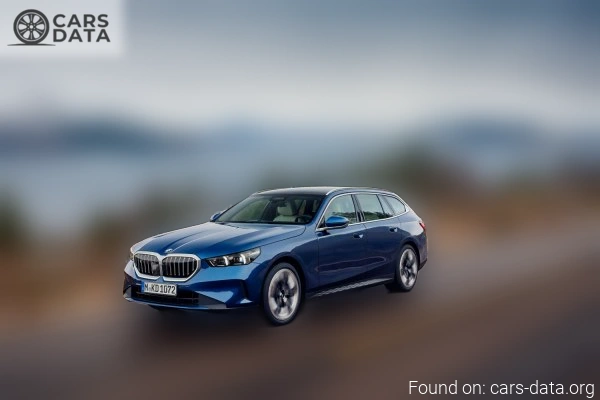
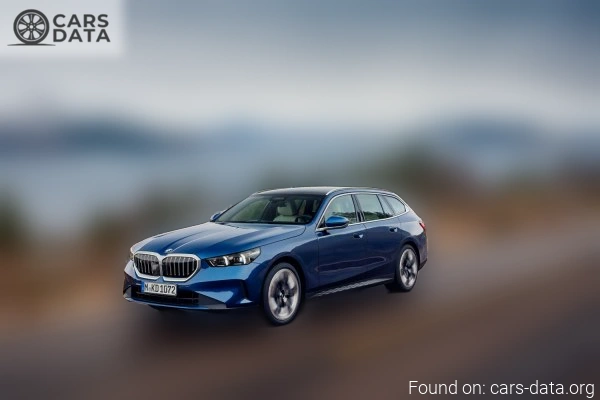
The BMW 5 Series boasts impressive acceleration, reaching 0-100 km/h (0-62 mph) in 6.4 seconds. Its top speed is 220 km/h (136.7 mph), and a low drag coefficient of 0.26 suggests good aerodynamic efficiency. Overall, the 5 Series demonstrates a balance of performance and efficiency.
Specs
-
Rating
Acceleration 0 100 Kmh
6.4 sec
Acceleration 0 62 Mph
6.4 sec
Max Speed
220 km/h 136.7 mph
Drag Coefficient Cd
0.26
Body & Dimensions
The BMW 5 Series Station Wagon is a spacious and well-proportioned 5-seater with a comfortable ride. Its dimensions (5060mm L x 1900mm W x 1515mm H) suggest a balance between interior room and maneuverability, aided by a relatively tight turning circle (12.3m). The longer wheelbase (2995mm) hints at a comfortable ride for passengers. While the ground clearance (147mm) is typical for a car of this class, it might not be ideal for rough terrains.
Specs
-
Rating
Body Type
Station wagon (estate)
Seats
5
Doors
5
Length
5060 mm 199.21 in.
Width
1900 mm 74.8 in.
Width Including Mirrors
2156 mm 84.88 in.
Height
1515 mm 59.65 in.
Wheelbase
2995 mm 117.91 in.
Front Track
1634 mm 64.33 in.
Rear Track
1668 mm 65.67 in.
Min Turning Circle
12.3 m 40.35 ft.
Ride Height Ground Clearance
147 mm 5.79 in.
Fuel Consumption
The BMW 5 Series, available with a petrol/electric powertrain, meets Euro 6e emission standards. Fuel efficiency, as measured by WLTP, is quite impressive, with combined consumption ranging from 0.7 to 0.9 liters per 100 kilometers (336.02 - 261.35 US mpg, 403.54 - 313.87 UK mpg, 142.86 - 111.11 km/l). CO2 emissions are similarly low, at 16-21 grams per kilometer.
Specs
-
Rating
Fuel Type
Petrol / electricity
Emission Standard
Euro 6e
Combined Fuel Consumption Wltp
0.7-0.9 l/100 km 336.02 - 261.35 US mpg 403.54 - 313.87 UK mpg 142.86 - 111.11 km/l
Co2 Emissions Wltp
16-21 g/km
Engine & Transmission
The BMW 5 Series PHEV boasts a potent 299 hp system output from its 190 hp 2.0L turbocharged inline-4 engine combined with an electric motor. This setup delivers 450 Nm of torque, channeled to the rear wheels via an 8-speed Steptronic automatic transmission. Advanced features include VALVETRONIC and Double-VANOS valvetrain technology, along with a sophisticated multi-link rear suspension and air suspension options. The plug-in hybrid powertrain allows for both electric-only and combined driving modes, offering efficiency and performance.
Independent multi-link suspension, Air suspension, Transverse stabilizer
System Power
299 Hp
System Torque
450 Nm 331.9 lb.-ft.
Engine Systems
Start & Stop System Particulate filter
Brakes
The 5 Series boasts a sophisticated braking system with ventilated disc brakes at both front and rear axles. Electric power steering enhances driver control, while the 19-inch wheel and tire configuration (245/45 R19 front, 275/40 R19 rear) suggests a balance of handling and ride comfort. The car also includes standard ABS (Anti-lock Braking System) and a steering rack and pinion system for precise steering response. The larger 10J x 19 rear wheel rims indicate a focus on handling and performance.
Specs
-
Rating
Front Brakes
Ventilated discs
Rear Brakes
Ventilated discs
Assisting Systems
ABS (Anti-lock braking system)
Steering Type
Steering rack and pinion
Power Steering
Electric Steering
Tires Size
Front wheel tires: 245/45 R19 Rear wheel tires: 275/40 R19
Wheel Rims Size
Front wheel rims: 8.5J x 19 Rear wheel rims: 10J x 19
Battery - Electric / Hybrid
The 5 Series electric vehicle boasts a relatively compact 22.1 kWh lithium-ion battery pack, located beneath the floor. This powers a synchronous electric motor generating 184 hp and 250 Nm of torque, positioned between the combustion engine and transmission. The car offers a range of 83-95 km (51.57 - 59.03 mi) on a single charge, with energy consumption figures ranging from 20.6-22.6 kWh/100 km. Charging is facilitated via a Type 2 AC connection on the front left. The car's top speed in electric mode is 140 km/h (86.99 mph).
Between the combustion engine and the transmission
Electric Motor Type
Synchronous
Net Usable Battery Capacity
19.4 kWh
All Electric Range Wltp
83-95 km 51.57 - 59.03 mi
Average Energy Consumption Wltp
20.6-22.6 kWh/100 km 33.15 - 36.37 kWh/100 mi 102 - 93 MPGe 4.9 - 4.4 km/kWh 3 - 2.7 mi/kWh
Battery Voltage
347.5 V
Weight & Capacity
The 5 Series boasts a relatively balanced weight-to-power and weight-to-torque ratio, suggesting a decent performance. Its kerb weight is substantial, but the maximum weight and load capacity indicate a vehicle designed for carrying passengers and cargo. The fuel tank capacity is average, and the trunk space offers a good amount of flexibility, expanding from a minimum of 570 liters to a maximum of 1700 liters. Towing capacity is moderate, with a permissible trailer load of 1800 kg with brakes and 750 kg without. Roof load capacity is also limited to 100 kg.
The 5 Series wagon offers a generous cargo capacity, though the exact volume would depend on the specific trim and configuration. Its overall dimensions suggest ample space for luggage and other items.
The relatively small turning circle (12.3m) makes parking easier compared to cars with larger turning radii. However, its overall width (including mirrors) should be considered when parking in tight spaces.
Fuel efficiency depends on the engine type and driving style. Consult the official BMW specifications for the specific model and engine to get accurate fuel economy figures.
The 5 Series accelerates from 0 to 100 km/h (0-62 mph) in 6.4 seconds and has a top speed of 220 km/h (136.7 mph).
The drag coefficient (Cd) is 0.26, indicating good aerodynamic efficiency.
Yes, the 5 Series demonstrates a quick acceleration time, making it a relatively fast car in its class.
The 5 Series is available with a petrol/electric powertrain.
CO2 emissions are between 16 and 21 grams per kilometer, depending on the specific model and driving conditions.
Fuel efficiency varies from 0.7 to 0.9 liters per 100 kilometers, depending on the specific model and driving conditions.
Fuel efficiency will vary depending on driving style and usage of the electric motor. However, PHEVs generally offer better fuel economy than comparable gasoline-only vehicles, especially in city driving.
The all-electric range depends on factors like battery condition, driving style, and weather. Check the manufacturer's specifications for the exact range.
Charging time varies depending on the charger used. A Level 2 charger will typically charge the battery faster than a Level 1 charger.
The car has electric power steering.
The front tires are 245/45 R19 and the rear tires are 275/40 R19.
The car includes ABS (Anti-lock Braking System).
Lithium-ion (Li-Ion) technology powers the vehicle.
The electric motor is positioned between the combustion engine and the transmission.
The all-electric range is between 83-95 km (51.57 - 59.03 mi) according to WLTP.
The maximum weight the car can carry is 2740 kg (6040.67 lbs), and the maximum load is 675 kg (1488.12 lbs).
The car can tow up to 1800 kg (3968.32 lbs) with brakes and 750 kg (1653.47 lbs) without brakes.
The trunk space ranges from a minimum of 570 liters (20.13 cu. ft.) to a maximum of 1700 liters (60.03 cu. ft.).