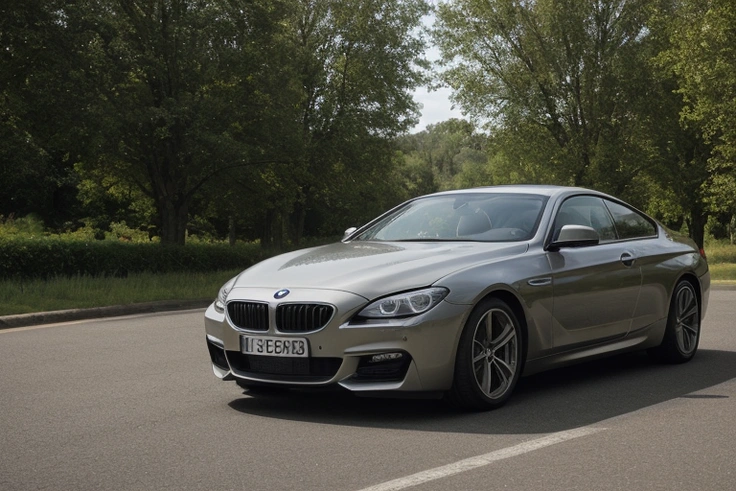
The 6 Series boasts a responsive performance, accelerating from 0 to 100 km/h (0-62 mph) in a brisk 9 seconds. Its top speed reaches 220 km/h (136.7 mph), and a drag coefficient of 0.41 suggests good aerodynamic efficiency. Overall, the car offers a balance of speed and efficiency.
Specs
-
Rating
Acceleration 0 100 Kmh
9 sec
Acceleration 0 62 Mph
9 sec
Max Speed
220 km/h 136.7 mph
Drag Coefficient Cd
0.41
Body & Dimensions
The BMW 6 Series Coupe is a stylish and sporty 2-door coupe offering seating for four. Its relatively compact dimensions (4815mm length, 1725mm width, 1365mm height) provide agile handling, enhanced by a 2625mm wheelbase and a tight turning circle of 11.7 meters. While compact, the interior dimensions suggest comfortable seating for four adults, though rear passengers might find legroom slightly limited given the coupe body style.
Specs
-
Rating
Body Type
Coupe
Seats
4
Doors
2
Length
4815 mm 189.57 in.
Width
1725 mm 67.91 in.
Height
1365 mm 53.74 in.
Wheelbase
2625 mm 103.35 in.
Front Track
1435 mm 56.5 in.
Rear Track
1465 mm 57.68 in.
Min Turning Circle
11.7 m 38.39 ft.
Fuel Consumption
The BMW 6 Series, a petrol-powered vehicle, demonstrates relatively high fuel consumption, particularly in urban settings (17.5 l/100km). However, fuel efficiency improves significantly on extra-urban drives (8 l/100km), resulting in a combined consumption of 11.9 l/100km. This suggests the car is more suited for longer journeys than city driving. Performance and luxury features should be considered alongside this moderate fuel economy.
Specs
-
Rating
Fuel Type
Petrol (Gasoline)
Fuel Consumption Urban
17.5 l/100 km 13.44 US mpg 16.14 UK mpg 5.71 km/l
Fuel Consumption Extra Urban
8 l/100 km 29.4 US mpg 35.31 UK mpg 12.5 km/l
Fuel Consumption Combined
11.9 l/100 km 19.77 US mpg 23.74 UK mpg 8.4 km/l
Engine & Transmission
The 6 Series boasts a naturally aspirated, inline 6-cylinder engine (M30B35) with a displacement of 3.4 liters. Producing 211 horsepower at 5700 RPM and 305 Nm of torque at 4000 RPM, it's a classic internal combustion engine layout driving the rear wheels. The car features a 4-speed automatic transmission and independent suspension front and rear. Engine oil capacity is 5.8 liters, and coolant capacity is 12 liters.
Specs
-
Rating
Powertrain Architecture
Internal Combustion engine
Power
211 Hp @ 5700 rpm.
Power Per Litre
61.5 Hp/l
Torque
305 Nm @ 4000 rpm. 224.96 lb.-ft. @ 4000 rpm.
Engine Layout
Front, Longitudinal
Engine Model Code
M30B35
Engine Displacement
3430 cm3 209.31 cu. in.
Number Of Cylinders
6
Engine Configuration
Inline
Cylinder Bore
92 mm 3.62 in.
Piston Stroke
86 mm 3.39 in.
Compression Ratio
9:1
Number Of Valves Per Cylinder
2
Fuel Injection System
Multi-port manifold injection
Engine Aspiration
Naturally aspirated engine
Engine Oil Capacity
5.8 l 6.13 US qt | 5.1 UK qt
Engine Oil Specification
15W-40, 15W-50 / API SF
Coolant
12 l 12.68 US qt | 10.56 UK qt
Drivetrain Architecture
The Internal combustion engine (ICE) drives the rear wheels of the vehicle.
Drive Wheel
Rear wheel drive
Number Of Gears And Type Of Gearbox
4 gears, automatic transmission
Front Suspension
Independent, type McPherson with coil spring and anti-roll bar
Rear Suspension
Independent coil spring
Brakes
This 6 Series model boasts ventilated disc front brakes and disc rear brakes, providing decent stopping power. The 220/55 VR 390 tire size suggests a focus on performance and handling, while the cone worm steering with recirculation balls indicates a system that prioritizes feedback and precision, though potentially at the cost of some modern conveniences like power assist. Overall, the specifications point towards a sporty driving experience.
Specs
-
Rating
Front Brakes
Ventilated discs
Rear Brakes
Disc
Steering Type
Cone worm with recirculation balls
Tires Size
220/55 VR 390
Weight & Capacity
The 6 Series boasts impressive power-to-weight and torque-to-weight ratios (7.1 kg/Hp and 4.9 kg/Nm respectively), suggesting brisk acceleration. Its relatively light kerb weight (1495 kg) contributes to this performance. The fuel tank capacity of 70 liters provides decent range, and the 413-liter trunk offers practical cargo space. The maximum load capacity of 400kg is suitable for everyday use and light hauling.
The 6 Series has a 4-speed automatic transmission.
While it has four seats, the rear seats are best suited for shorter journeys or smaller passengers due to the coupe's sloping roofline.
Fuel efficiency varies depending on the specific engine and year of the 6 Series. It's best to consult the specifications for the exact model year you are interested in.
Yes, its relatively small size and 11.7-meter turning circle make it fairly easy to maneuver, even in tight city spaces.
Approximately 9 seconds.
136.7 mph.
A drag coefficient of 0.41 suggests good aerodynamic efficiency, meaning the car experiences less air resistance while driving.
No, it's not particularly fuel-efficient, especially in city driving. Its fuel consumption is higher than many comparable models.
The combined fuel consumption is 11.9 liters per 100 kilometers.
Fuel efficiency is significantly better on extra-urban roads (8 l/100km) compared to city driving (17.5 l/100km).
The 6 Series has a naturally aspirated, inline 6-cylinder internal combustion engine.
The car produces 211 horsepower at 5700 RPM and 305 Nm of torque at 4000 RPM.
It features ventilated disc brakes in the front and disc brakes in the rear.
Cone worm steering offers direct feedback and precise control, but may require more effort than power-assisted systems.
The tire size (220/55 VR 390) doesn't specify the tire type. Further information is needed to determine all-weather suitability.
The 6 Series has historically offered a range of powerful inline-6 and V8 engines, often with options for rear-wheel drive or all-wheel drive.
Yes, its comfortable interior, refined ride, and available advanced driver-assistance systems make it well-suited for long journeys.
Fuel economy varies depending on the engine and drivetrain, but generally, it's expected to be in line with other luxury grand tourers – not exceptionally high, but reasonable for its performance.
Fuel efficiency isn't in the specs, but the power-to-weight ratio suggests it could be relatively good, depending on driving style and engine type.
The specs don't list towing capacity. Consult the owner's manual for this information.
The 413-liter trunk is reasonably sized for everyday needs, but larger families might find it limiting for longer trips. Consider the specific needs of your family.