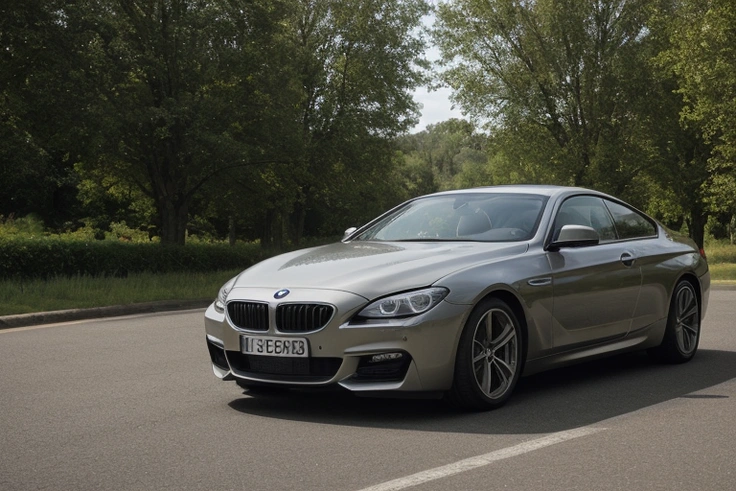
The 6 Series boasts respectable performance with a 0-100 km/h acceleration of 8.4 seconds and a top speed of 225 km/h. Its aerodynamic efficiency is evident in its relatively low drag coefficient of 0.41. While not exceptionally fast, it offers a good balance of performance and likely fuel efficiency for a car in its class.
Specs
-
Rating
Acceleration 0 100 Kmh
8.4 sec
Acceleration 0 62 Mph
8.4 sec
Max Speed
225 km/h 139.81 mph
Drag Coefficient Cd
0.41
Body & Dimensions
The 6 Series Coupe is a compact, sporty coupe with a sleek design. Its dimensions suggest a relatively spacious interior for a two-door coupe, with a long wheelbase and a relatively narrow width. The substantial turning circle indicates a maneuverability that might be less agile than some competitors.
Specs
-
Rating
Body Type
Coupe
Seats
4
Doors
2
Length
4815 mm 189.57 in.
Width
1725 mm 67.91 in.
Height
1365 mm 53.74 in.
Wheelbase
2625 mm 103.35 in.
Front Track
1435 mm 56.5 in.
Rear Track
1465 mm 57.68 in.
Min Turning Circle
11.7 m 38.39 ft.
Fuel Consumption
The 6 Series, a petrol-powered vehicle, demonstrates decent fuel efficiency. While urban driving consumes a relatively high 16.9 l/100km, extra-urban fuel consumption drops significantly to 7.8 l/100km, resulting in a combined figure of 11.5 l/100km. This suggests the car is more economical for highway driving than city driving. Overall, fuel efficiency is moderate, suitable for drivers who prioritize performance over extreme fuel economy.
Specs
-
Rating
Fuel Type
Petrol (Gasoline)
Fuel Consumption Urban
16.9 l/100 km 13.92 US mpg 16.71 UK mpg 5.92 km/l
Fuel Consumption Extra Urban
7.8 l/100 km 30.16 US mpg 36.22 UK mpg 12.82 km/l
Fuel Consumption Combined
11.5 l/100 km 20.45 US mpg 24.56 UK mpg 8.7 km/l
Engine & Transmission
This 6 Series model boasts a naturally aspirated 3.4L inline-6 M30 engine, producing 220hp and 315Nm of torque. Power is sent to the rear wheels via a 4-speed automatic transmission. The car features a comfortable ride with independent front (McPherson strut) and rear coil spring suspension. While the technology is dated by modern standards, the classic inline-6 engine provides a smooth and refined driving experience.
Specs
-
Rating
Powertrain Architecture
Internal Combustion engine
Power
220 Hp @ 5700 rpm.
Power Per Litre
64.1 Hp/l
Torque
315 Nm @ 4000 rpm. 232.33 lb.-ft. @ 4000 rpm.
Engine Layout
Front, Longitudinal
Engine Model Code
M30
Engine Displacement
3430 cm3 209.31 cu. in.
Number Of Cylinders
6
Engine Configuration
Inline
Cylinder Bore
92 mm 3.62 in.
Piston Stroke
86 mm 3.39 in.
Compression Ratio
9.2:1
Number Of Valves Per Cylinder
2
Fuel Injection System
Multi-port manifold injection
Engine Aspiration
Naturally aspirated engine
Engine Oil Capacity
5.75 l 6.08 US qt | 5.06 UK qt
Engine Oil Specification
15W-40, 15W-50 / API SF
Coolant
12 l 12.68 US qt | 10.56 UK qt
Drivetrain Architecture
The Internal combustion engine (ICE) drives the rear wheels of the vehicle.
Drive Wheel
Rear wheel drive
Number Of Gears And Type Of Gearbox
4 gears, automatic transmission
Front Suspension
Independent, type McPherson with coil spring and anti-roll bar
Rear Suspension
Independent coil spring
Brakes
The 6 Series boasts ventilated disc front brakes and disc rear brakes, suggesting good stopping power. The 220/55 VR 390 tires indicate a likely focus on handling and performance, while the cone worm with recirculation balls steering type suggests a balance between precision and responsiveness. Overall, the specifications point to a car likely designed for a comfortable and engaging driving experience.
Specs
-
Rating
Front Brakes
Ventilated discs
Rear Brakes
Disc
Steering Type
Cone worm with recirculation balls
Tires Size
220/55 VR 390
Weight & Capacity
The 6 Series boasts impressive power-to-weight and torque-to-weight ratios (6.7 kg/Hp and 4.7 kg/Nm respectively), suggesting strong performance. With a kerb weight of 1480kg and a maximum load capacity of 400kg, it offers a decent balance between agility and carrying capacity. The 70-liter fuel tank provides a reasonable range, and the 413-liter trunk offers practical storage space.
The 6 Series Coupe is approximately 189.57 inches (4815 mm) long.
The car has four seats.
The minimum turning circle is 11.7 meters (38.39 feet).
It has a top speed of 225 km/h (139.81 mph).
The 0-62 mph acceleration is 8.4 seconds; 0-60 mph would be slightly quicker.
It has a drag coefficient of 0.41, indicating decent aerodynamic efficiency.
Fuel consumption is relatively high in urban areas at 16.9 l/100km, which is expected for a performance-oriented vehicle.
The 6 Series is much more fuel-efficient on highways, with a consumption rate of 7.8 l/100km.
While not the most fuel-efficient car, its combined fuel consumption is acceptable for its class. Drivers prioritizing extreme fuel economy should consider other models.
It's equipped with a naturally aspirated 3.4L inline-6 cylinder engine (M30).
It produces 220hp at 5700 rpm and 315Nm of torque at 4000 rpm.
It has a 4-speed automatic transmission.
Ventilated disc brakes allow for better heat dissipation, which is crucial for sustained performance during hard braking, especially in high-speed driving or aggressive driving conditions.
The tire size indicates the width, aspect ratio, construction type (VR for radial), and diameter of the tire. This size is commonly found on cars that prioritize a balance of handling and comfort.
This steering type is a mechanical system that provides a direct connection between the steering wheel and the wheels. It typically offers a more precise and responsive feel compared to other types of steering systems.
This depends on the specific model year and trim level. Generally, expect a range of powerful inline-6 and V8 engines, potentially with hybrid or plug-in hybrid options.
Pricing varies significantly based on the specific model, trim, and condition. Expect a premium price point compared to more mainstream models.
Expect features like advanced infotainment systems, premium leather interiors, and sophisticated driver-assistance technologies.
Fuel efficiency isn't in the specs, but given the performance figures, it's likely to be moderate rather than exceptional.
Towing capacity isn't specified in these details. Consult the owner's manual for precise towing information.
The data doesn't include acceleration figures. This would need to be sourced from independent testing or reviews.