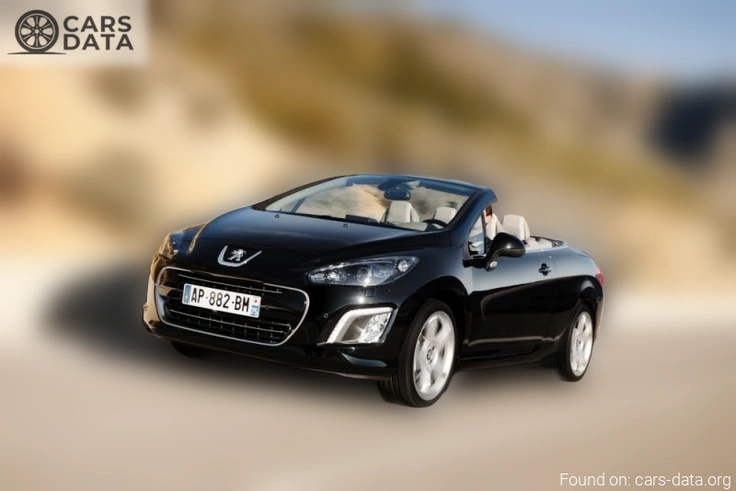
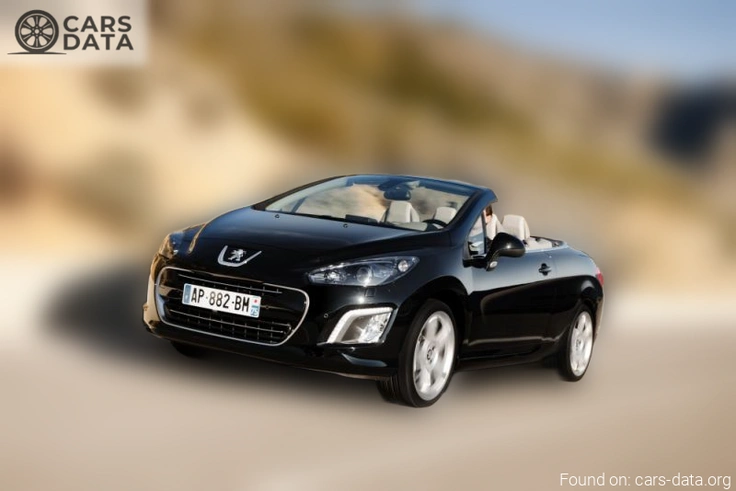
The Peugeot 308 is a compact coupe-cabriolet with seating for four passengers and two doors. The car has a length of 4400 mm (173.23 in.), a width of 1872 mm (73.7 in.), and a height of 1426 mm (56.14 in.). The wheelbase is 2605 mm (102.56 in.), with a front track of 1526 mm (60.08 in.) and a rear track of 1521 mm (59.88 in.). The minimum turning circle is 10.74 m (35.24 ft.).
Specs
-
Rating
Body Type
Coupe - Cabriolet
Seats
4
Doors
2
Length
4400 mm 173.23 in.
Width
1872 mm 73.7 in.
Height
1426 mm 56.14 in.
Wheelbase
2605 mm 102.56 in.
Front Track
1526 mm 60.08 in.
Rear Track
1521 mm 59.88 in.
Min Turning Circle
10.74 m 35.24 ft.
Fuel Consumption
The Peugeot 308 Diesel is a fuel-efficient car with a combined fuel consumption of 4.6 liters per 100 kilometers, producing 119 grams of CO2 per kilometer. It has a Euro 5 emission standard and is available in diesel fuel type.
Specs
-
Rating
Fuel Type
Diesel
Emission Standard
Euro 5
Fuel Consumption Urban
5.3 l/100 km 44.38 US mpg 53.3 UK mpg 18.87 km/l
Fuel Consumption Extra Urban
4.2 l/100 km 56 US mpg 67.26 UK mpg 23.81 km/l
Fuel Consumption Combined
4.6 l/100 km 51.13 US mpg 61.41 UK mpg 21.74 km/l
Co2 Emissions
119 g/km
Engine & Transmission
The car in question is a 308 model with a 1.5-liter, 4-cylinder, inline, turbocharged diesel engine with intercooler and common rail fuel injection system. The engine produces 115 horsepower at 3600 rpm and 285 Nm of torque at 1750 rpm. The engine is transversely mounted at the front and drives the front wheels via a 6-speed manual transmission. The car has a front independent suspension with a coil spring and anti-roll bar, and a semi-independent suspension at the rear with a coil spring. The car has a front-wheel-drive architecture.
Specs
-
Rating
Powertrain Architecture
Internal Combustion engine
Power
115 Hp @ 3600 rpm.
Power Per Litre
73.7 Hp/l
Torque
285 Nm @ 1750 rpm. 210.21 lb.-ft. @ 1750 rpm.
Engine Layout
Front, Transverse
Engine Model Code
9HC DV6C
Engine Displacement
1560 cm3 95.2 cu. in.
Number Of Cylinders
4
Engine Configuration
Inline
Number Of Valves Per Cylinder
2
Fuel Injection System
Diesel Commonrail
Engine Aspiration
Turbocharger, Intercooler
Engine Oil Capacity
3.75 l 3.96 US qt | 3.3 UK qt
Engine Oil Specification
5W-30 / PSA B71 2290
Coolant
6 l 6.34 US qt | 5.28 UK qt
Drivetrain Architecture
The Internal combustion engine (ICE) drives the front wheels of the vehicle.
Drive Wheel
Front wheel drive
Number Of Gears And Type Of Gearbox
6 gears, manual transmission
Front Suspension
Independent, type McPherson with coil spring and anti-roll bar
Rear Suspension
Semi-independent, coil spring
Brakes
The Peugeot 308 is equipped with ventilated discs in the front and discs in the rear, with ABS (Anti-lock braking system) for enhanced safety. The car features a steering rack and pinion system and comes with 205/55 R16 V tires on 16-inch wheel rims.
Specs
-
Rating
Front Brakes
Ventilated discs
Rear Brakes
Disc
Assisting Systems
ABS (Anti-lock braking system)
Steering Type
Steering rack and pinion
Tires Size
205/55 R16 V
Wheel Rims Size
16
Weight & Capacity
The Peugeot 308 is a well-balanced car with a good power-to-weight ratio of 13.3 kg/Hp and a torque-to-weight ratio of 5.4 kg/Nm. It has a kerb weight of 1535 kg and a maximum weight of 1950 kg. The car has a decent boot space of 226-403 liters and a fuel tank capacity of 60 liters.